







Search results for: Blue
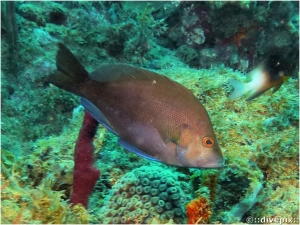
Tan Hamlet
| Aspect: |
Uniform dark tan body, lighter towards the head and belly, no particular markings. |
| Population: | Uncommon, and in fact only recently formally described and named as "Hypoplectrus randallorum", as confirmed by WORMS (see here). Easily mistaken for a small snapper although both the almond-shaped eyes and blue ventral and anal fins eliminate the option. Until recently (2011) the only reference book that actually identified it as "Tan Hamlet" was Humann's Reef Fish Identification which gave the scientific name "Hypoplectrus sp.". |
| Notable feature: | Blue ventral and anal fins, with first spine of ventral fins lighter blue. Dark brown tail fin. |
| Environment: | Near bottom, close to rocks or coral boulders able to provide shelter. |
| Behaviour: | Not too shy if approached gently. |
Cherubfish
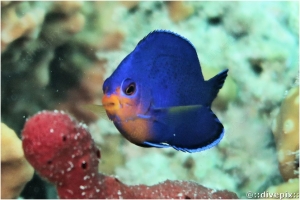
| Aspect: | Against all odds, this is not a Damselfish that made up for Carnival celebrations, but a genuine Angelfish and thus belongs to the Pomacanthidae family. Bright blue body and yellow face and chest. |
| Population: | So far unknown to the Ilets Pigeon reserve, but may be encountered - as is the case of this specimen - in the South of Guadeloupe around the Saintes islands. |
| Notable feature: | Blue ring around the eyes, and always has a blue tail: fins are bordered by a lighter blue line. |
| Environment: | Shallow waters |
| Behaviour: | Very wary. |
Encrusting Fan-Leaf Alga
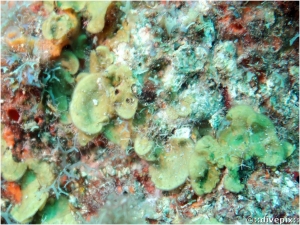
| Aspect: | Flat semi-circular blades (leaves), colour ranging from green to light brown to yellow. Grow flat and spread over relatively wide surfaces, leaves overlapping one another. |
| Population: | Widespread. |
| Notable feature: |
Belongs to the Brown Algae category in spite of its predominent green colour (algae are subdivided into four colours: Brown, Green, Red and Blue-Green. |
| Environment: | Grows over small flatfish surfaces at the foot of rockky formations. |
| Behaviour: | - |
Lesser Starlet Coral
| Aspect: |
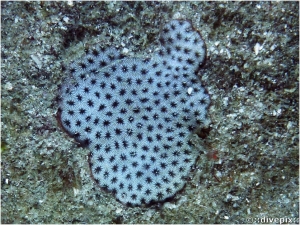
Flat encrusting formation of small, deep-cored corallites. |
| Population: | Common. |
| Notable feature: |
Colour usually grey-blue. |
| Environment: | Found at depths of a few metres to 15 or 20 metres. |
| Behaviour: | Polyps extend at night. |
Shy Hamlet

| Aspect: | Bright yellow oval body with a resolutely protruding snout and large dark blue (to black) after body, although tail fin, belly and all other fins remain bright yellow. |
| Population: | Still scarce, but like the Queen Angelfish (inter alia) tends to reappear around Ilets Pigeon in 2016. |
| Notable feature: | Electric blue-surrounded elongated black patch between the eyes and the upper lip. Often mistaken from a distance for Rock Beauty Angelfish (q.v.) |
| Environment: | Close to bottom, around rocks and coral boulders that offer quick shelter. |
| Behaviour: | Wary, but may remain still if approached cautiously. |
Y-Branched Alga, or Y Branched Alga

| Aspect: | Flat blades, usually green or green with blue or brown tones, that fork off in Y patterns - hence their English designation. Can spread over relatively wide surfaces. |
| Population: | Widespread. |
| Notable feature: |
Belongs to the Brown Algae category in spite of its usually predominent green colour (algae are subdivided into four colours: Brown, Green, Red and Blue-Green. |
| Environment: | Can grow over many substrates, and as exemplified by some of the photographs herewith, can even develop over leaf corals. |
| Behaviour: | - |
Dusky Damselfish
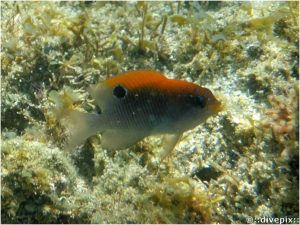
| Aspect: |
Adult is brown and almost similar to Longfin Damselfish (q.v.), but dorsal fin does not extend beyond the root of the tail fin. Juvenile features a bright orange dorsal coat from snout to near the tail area, tail that washes out into a paler shade on the sides and finally into whitish belly and tail fin areas. |
| Population: | Less common than other Damselfishes. |
| Notable feature: | Juvenile: Dorsal fin features a white-bezelled dark spot in it s after half, and a similar but smaller stain saddes the tail root. Nose and eyes are adorned with seemingly fluo blue dots that fade past the gill area. |
| Environment: | Usually found in shallow waters around rocks down to a maximum depth of 15 metres. |
| Behaviour: | Will usually tolerate a diver's quiet presence, but constantly moves and is thus difficult to photograph. |
Spotted Cleaner Shrimp
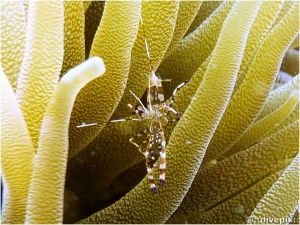
| Aspect: |
Brown and white dominantly coloured shrimp, with banded front legs and light brown-and-white roundel-adorned tail and long brown-banded white antennae. Body itself is tranlucid with tiny purple dots, main white legs are brown-banded and tipped with blue/purple claws while other legs are purple-banded white. |
| Population: | Common. |
| Notable feature: | May be mistaken for the smaller Squat Anemone Shrimp (q.v.), which has much shorter antennae and far more discrete legs. |
| Environment: | Typically found in giant anemones. |
| Behaviour: | Will usually try to hide if approached too closely. |
Blue or Pink Icing Sponge spp.
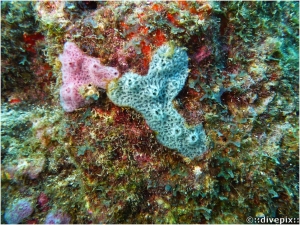
| Aspect: |
Preliminary Remark: The species seen here has not been formally identified and to our knowledge does not appear to have been described. Pink or blue, this encrusting sponge shares similar texture features with the Orange Icing Sponge (q.v.), particularly a loose texture giving an appearance of decay. It also features similar transparent excurrent chimney brims, but does not appear to spread under sheets of coral. |
| Population: | Rare, first seen in late 2015 around Ilets Pigeon. |
| Notable feature: | - |
| Environment: | Rocky substrate. |
| Behaviour: | - |
Beaugregory
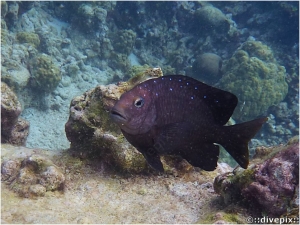
| Aspect: | All Damselfishes have similar outlines, but with more or less deeply pronounced "chin-pectoral" area and dorsal fin tips of various shapes. |
| Population: | Not as abundant as other Damselfishes. |
| Notable feature: | Difficult to distinguish it from the Longfin Damselfish, but is the only one to sometimes sport blue spots, like the young/adult Yellowtail Damselfish (q.v.). |
| Environment: | Rocky areas, coral boulders. |
| Behaviour: | Can be approached (except juvenile), curious, but constantly moves. |